VI-grade and Aidoptation Announce Strategic Collaboration to Advance High-Speed Autonomous Driving Safety
Udine, Italy, September 28th, 2026 – VI-grade, the global provider of human-centric simulation-driven vehicle development solutions, and Aidoptation, a Belgium-based deep-tech company developing EdgeDrive, an ADAS for Level 4 autonomous driving on highways, today announced a strategic collaboration focused on advancing the development and validation of autonomous driving technologies at highway speeds (120-130 km/h). The collaboration addresses a key challenge in autonomous driving development: safely and systematically validating edge cases at high speeds, where vehicle dynamics, stability and tire grip become increasingly critical. By combining VI-grade’s high-fidelity vehicle and driving simulation capabilities with Aidoptation’s autonomous driving technology and physical testing expertise, the companies aim to establish a robust simulation-to-real validation approach for Level 3 and Level 4 highway driving.
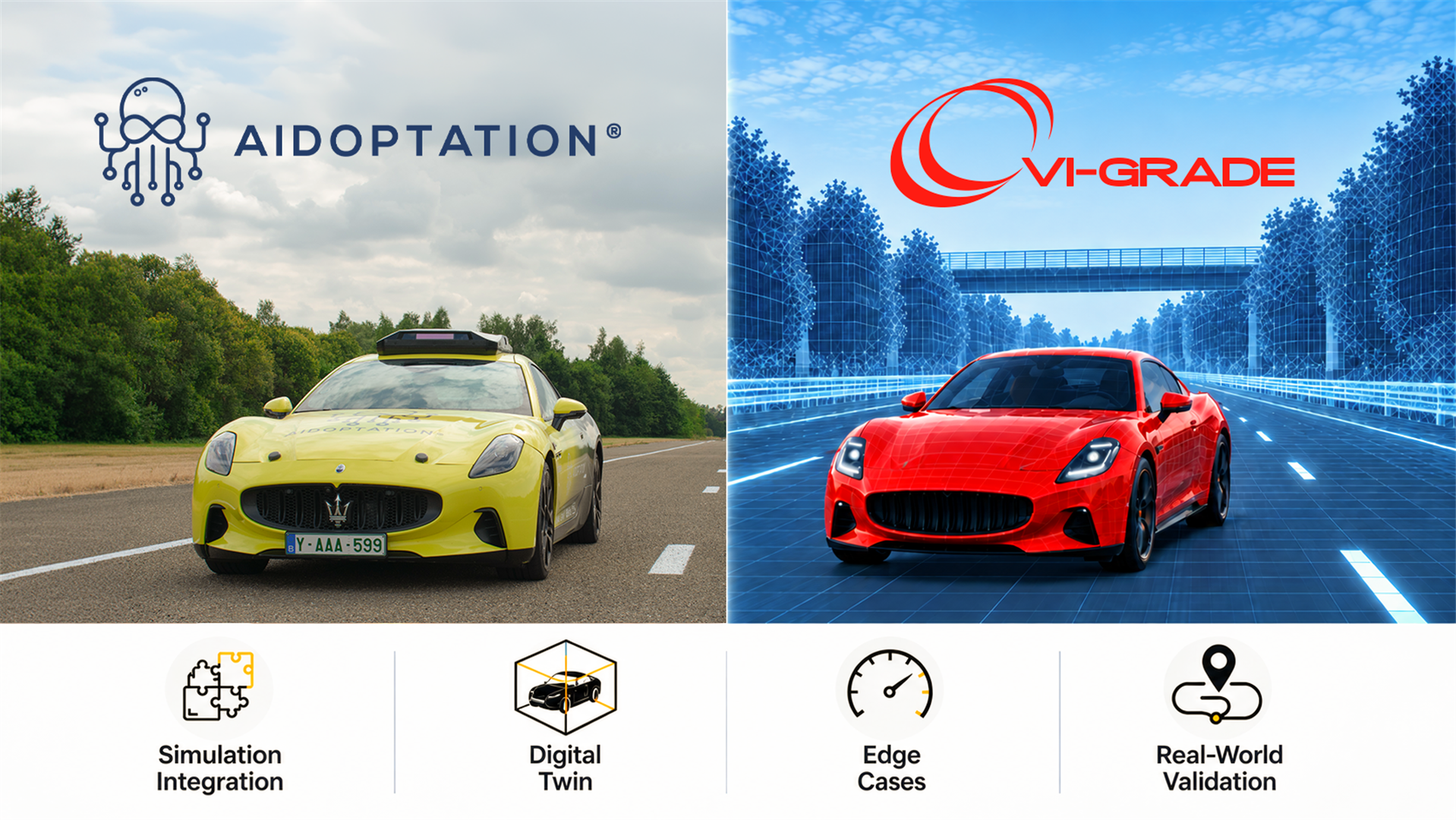
At the core of the collaboration is the integration of VI-WorldSim and VI-CarRealTime with Aidoptation’s EdgeDrive deterministic safety layer. Vehicle dynamics, road geometry, traffic objects and sensor information generated within the VI-grade simulation environment will be connected with EdgeDrive, enabling autonomous driving responses to be evaluated across controlled and repeatable virtual scenarios. The project also includes the development of a validated virtual representation of Aidoptation’s physical test vehicle, using vehicle dynamics data collected during proving-ground testing to strengthen correlation between virtual and physical testing.
In parallel, VI-grade and Aidoptation will develop a high-speed highway edge-case scenario library covering speeds from 120 to 130 km/h. VI-grade’s automated scenario-generation capabilities will be combined with Aidoptation’s maneuvers definitions, safety KPIs and pass/fail criteria, enabling systematic testing of scenarios that may be difficult, costly or risky to reproduce repeatedly with a physical vehicle.
The collaboration will ultimately connect virtual testing in VI-WorldSim with physical validation at Aidoptation’s test facilities and proving grounds. The goal is to establish a structured methodology for determining which scenarios can be validated effectively in simulation and where physical testing remains necessary, supporting more efficient and scalable autonomous driving validation.
“High-speed highway operation introduces edge cases that need to be tested systematically and under highly repeatable conditions. By combining our deterministic safety technology and experience from physical vehicle testing with VI-grade’s simulation capabilities, we can create a continuous validation process from the virtual environment to safe real-world autonomous driving,” said Paul Mitchell, CEO of Aidoptation.
“Everything here depends on the fidelity of the models. With a vehicle dynamics model that reproduces how the car behaves at the limit of grip, and a world model that puts that behaviour in a realistic environment, we can validate a safety-critical manoeuvre before the vehicle ever runs it, and because EdgeDrive is deterministic, simulation and track agree. That compresses the development of each new manoeuvre from months to weeks,” said Rodrigo Senofieni, Head of Engineering at Aidoptation.
“One of the key advantages of simulation is the ability to reproduce complex and safety-critical situations under exactly controlled conditions and evaluate them repeatedly as the system evolves,” said Iain Dodds, NA Technical Director of VI-grade. “Our collaboration with Aidoptation connects this capability with real-world vehicle data and physical testing, helping create a more efficient development and validation workflow for autonomous driving technologies.”
At the core of the collaboration is the integration of VI-WorldSim and VI-CarRealTime with Aidoptation’s EdgeDrive deterministic safety layer. Vehicle dynamics, road geometry, traffic objects and sensor information generated within the VI-grade simulation environment will be connected with EdgeDrive, enabling autonomous driving responses to be evaluated across controlled and repeatable virtual scenarios. The project also includes the development of a validated virtual representation of Aidoptation’s physical test vehicle, using vehicle dynamics data collected during proving-ground testing to strengthen correlation between virtual and physical testing.
In parallel, VI-grade and Aidoptation will develop a high-speed highway edge-case scenario library covering speeds from 120 to 130 km/h. VI-grade’s automated scenario-generation capabilities will be combined with Aidoptation’s maneuvers definitions, safety KPIs and pass/fail criteria, enabling systematic testing of scenarios that may be difficult, costly or risky to reproduce repeatedly with a physical vehicle.
The collaboration will ultimately connect virtual testing in VI-WorldSim with physical validation at Aidoptation’s test facilities and proving grounds. The goal is to establish a structured methodology for determining which scenarios can be validated effectively in simulation and where physical testing remains necessary, supporting more efficient and scalable autonomous driving validation.
“High-speed highway operation introduces edge cases that need to be tested systematically and under highly repeatable conditions. By combining our deterministic safety technology and experience from physical vehicle testing with VI-grade’s simulation capabilities, we can create a continuous validation process from the virtual environment to safe real-world autonomous driving,” said Paul Mitchell, CEO of Aidoptation.
“Everything here depends on the fidelity of the models. With a vehicle dynamics model that reproduces how the car behaves at the limit of grip, and a world model that puts that behaviour in a realistic environment, we can validate a safety-critical manoeuvre before the vehicle ever runs it, and because EdgeDrive is deterministic, simulation and track agree. That compresses the development of each new manoeuvre from months to weeks,” said Rodrigo Senofieni, Head of Engineering at Aidoptation.
“One of the key advantages of simulation is the ability to reproduce complex and safety-critical situations under exactly controlled conditions and evaluate them repeatedly as the system evolves,” said Iain Dodds, NA Technical Director of VI-grade. “Our collaboration with Aidoptation connects this capability with real-world vehicle data and physical testing, helping create a more efficient development and validation workflow for autonomous driving technologies.”
German version available here
English version available here